Nikon action photography pros will surely love the new D4
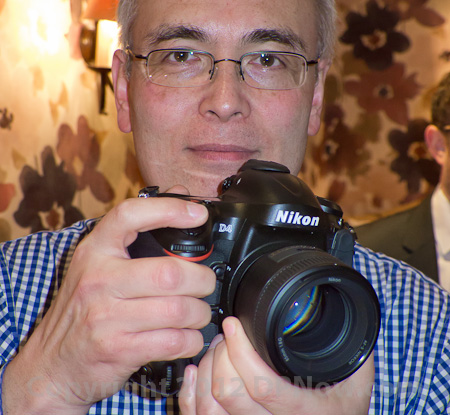
Nikon wowed professional photographers in August 2007 when it unveiled the D3, Nikon's first full-frame DSLR. Now more than four years on and we're moving up a generation, to the D4 (no superstition about the number '4' for Nikon this time) and while the D4 may not be as revolutionary as the D3 was, it still has that jaw-dropping effect when you plough through the list of features it boasts.

The new Nikon D4 fitted with the new 85mm f/1.8 Nikkor also launched today
New 16.2 megapixel sensor and Expeed 3 image processor
So where do we start? How about the sensor? It's full frame, as you'd expect, and increases to 16.2 effective megapixels. Thanks to the new sensor and Expeed 3 image processor you get up to 11 frames per second shooting and a maximum ISO sensitivity of 204800, meaning you can shoot at night in moonlight with realistic settings. Nikon has emphasised that the design of the D4 was highly influenced by feedback from existing D3 users. A popular request was for lower ISO speed settings and Nikon has endowed the D4 with an ISO 50 option. Nikon is especially pleased with the noise performance of the D4 and apparently the overhead on the image buffer you might expect due to noise processing is exceptionally low.
Improved AF and metering modules

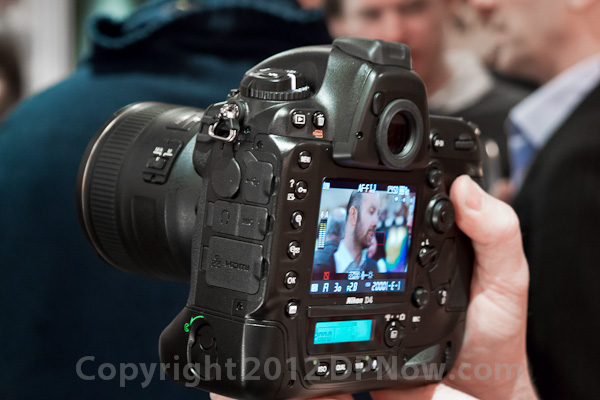
Look carefully and you can see the high degree of commonality between the controls when the camera is orientated normally and in portrait mode
Returning to the theme of shooting moonlight there is a new Multi-cam 3500 AF sensor with 51 AF points. It is rated to -2EV, meaning it can autofocus under moonlight if required. The enhanced AF sensitivity means that you can use teleconverters and still benefit from the availability of the 15 cross-type AF points as they will work with maximum apertures as dim as f/8. This means there is less need to bring big and heavy fast lenses when travelling light is a must.
We're all used to scene and face detection in live view mode, but the 91,000 pixel 3D Colour Matrix Metering III sensor module can now offer the same benefits in TTL DSLR mode. Cynics might dismiss this, but if you are hand holding a camera in difficult lighting conditions the benefits can soon be valued. Nikon says subject detection and tracking is better than ever thanks to 3D colour focus tracking.
Refined ergonomics
Ergonomic design is another area in which Nikon hopes the D4 will be appreciated. When shooting in near darkness under the moonlight you won't be lost trying to find the controls as not only are the LCD screens illuminated as normal, but most of the exterior buttons can be illuminated too. The angle of the shutter release button has been modified with the help of user-feedback and the control layouts when the camera is used in portrait and landscape orientations is now pretty much identical. If you have set an off-centre AF point it will maintain its position if the camera orientation is changed.

Nikon's redesign of the D3 chassis involved a lot of subtle refinements.
The shutter mechanism itself, which employs carbon fibre materials, is all new and designed to last longer than ever (400,000 cycles) and to reduce blanking times when shooting in live view mode. In order to comply with new regulations concerning battery safety, the D4's battery has a lower capacity rating than the D3. However the more efficient electronics and shutter mean the D4 can deliver more shots on a single charge than the D3. There is also a redesigned AF switch that avoids the possibility of setting a conflicting mode and it can be used without the need for the photographer to stop viewing the scene through the viewfinder.
A newly-developed 3.2 inch LCD monitor now dominates the back of the D4. It offers a colour space very close to that of sRGB and an external light sensor adjusts not only the brightness of the screen but also saturation and contrast to maintain a faithful as possible display. The construction of the LCD also aims to reduce changes when viewing at off-centre angles. A development of the dual axis virtual horizon level sensor from the D3s is in the D4.
Video capture
It was telling that the headline demo at the press launch to show off the D4's capabilities was a professionally created movie shot with pre-production D4s. Arguably a bonus feature on the original D3, video functionality now lies at the heart of the D4's design. You get Full HD 1920x1080p recording at 30, 25 or 24 frames per second. For slow motion work you can shoot at 720p in 60 or 50 frames per second. The microphone port's level can now be manually adjusted if required and there is visual level monitoring and an audio out port for real time listening. H.264 compression is now used and clips can be up to 29 minutes and 59 seconds in length instead of a measly 5 minutes. You can shoot in any ISO mode from ISO 200 to 204800. Uncompressed HDMI-out signal is featured.
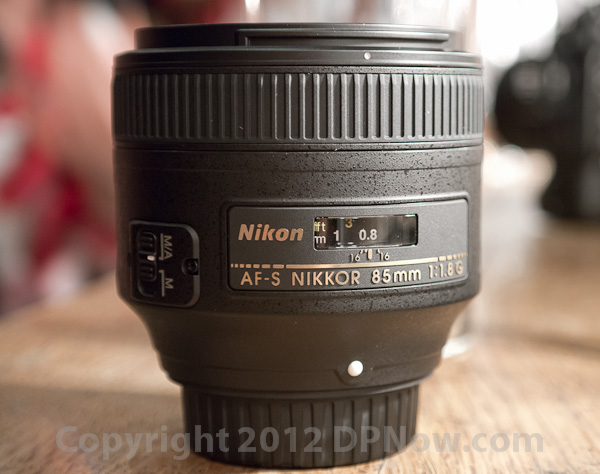
The new Nikkor AF-S 85mm f/1.8 G
Index marking is supported for easier editing, the aperture can be smoothly adjusted in Aperture priority and Manual exposure modes and it's possible to grab a 2 megapixel still frame while shooting video. Time lapse mode is supported and the camera will encode the frames so you can play the clip back immediately.
While the D4 is a full frame sensor camera the active area of the sensor can be adjusted to accommodate APS sensor DX lenses and to maximise depth of field an even smaller portion of the sensor can be used and still produce 1080HD resolution footage.
Workflow
Nikon has designed the D4 to be less dependent on the use of an accompanying laptop in the field. You can add and edit IPTC metadata through 14 fields and 10 presets, for a start. There is a standard size RJ45 port for an Ethernet cable. This enables PC control of the camera as well as FTP access. The camera also features its own HTTP web server and you can monitor the live view, focus, adjust settings, review pictures, and more, using a standard web browser, which could be via a tablet computer, PC or even a smartphone.
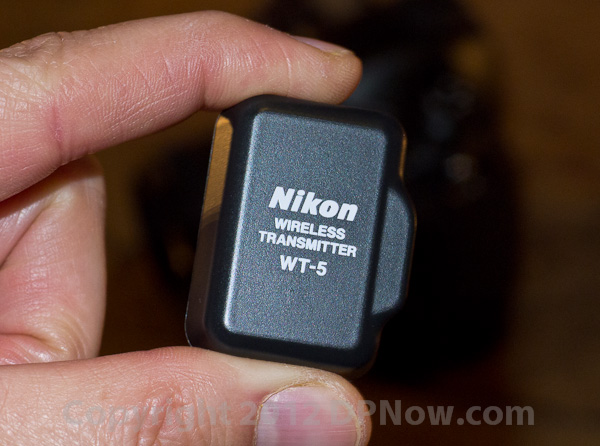
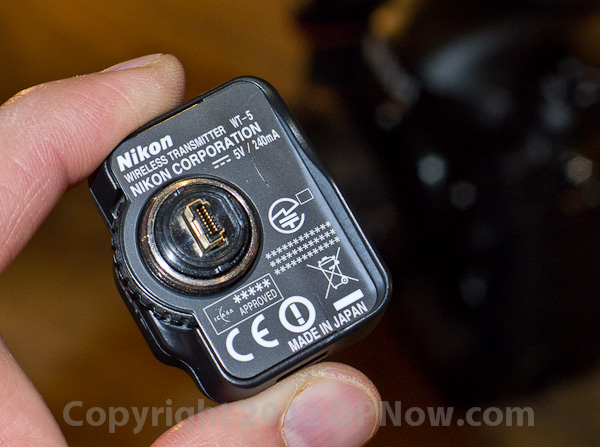
If a wired network connection is not convenient, a new WT-5 wireless transmitter has been developed for the D4, which now supports faster wireless N connections. You can still use the older WT-4 unit if you have one.
You can also fit a GP-1 GPS adapter and the camera's own clock can be kept accurately set from the GPS network's atomic clocks.
Memory card options

You might be surprised to find out that SD(HC) or even SDXC cards are not supported in the D4. This is because Nikon has supplemented the standard compact flash slot with a slot for the brand new XQD card standard developed jointly with Canon and Sandisk and overseen by the Compactflash Association. XQD cards are 25% smaller than CF cards and more robust than SD cards. Most importantly, thanks to the underlying PCI Express serial data transfer bus, they are very fast, with initial samples expected to offer 125MB/sec write rates and 250MB/sec read rates.
If you prefer to stick with what you know, at least to start with, the D4's CF slot is UDMA 7 compliant meaning it can support cards faster than 133MB/sec, like the newly-announced Lexar Pro 1000x UDMA 7 cards.
Nikon's own figures show that a D4 saving to an XQD card can continuously shoot 170 large fine JPEGs in 17 seconds before the buffer stalls, or 98 compress RAW files in 10 seconds. A D3s running a Sandisk Extreme IV card results in 82 JPEGs in 9.1 seconds or 43 RAWs in 4.3 seconds. A D4 with a UDMA 7 card returns results in between the two others.
Conclusion
On paper the D4 is easily the best camera Nikon has ever produced. Nikon sports, wildlife and action photography professionals should be queueing up for the D4 when it goes on sale in little over a month's time. The D4's designs and specification is a triumph that will surely earn grudging respect from Canon. But Canon's pre-announced EOS-1Dx does out-gun the D4 in some areas on paper. Canon can claim up to 14 frames per second shooting and 18.1 megapixels, as well as more AF points. It also has an Ethernet port and even a DLNA media server. So which of these titans will come out on top? It's impossible to say, but Nikon may beat Canon on shipping the D4 earlier. Nikon has also impressed with its pricing. The D4 has a guide price, body only, of £4799.99 inc.VAT, or €5658. That's a lot of camera for the money. And Nikon pros have plenty of time to master their new D4s before the London Olympics and of course Nikon is the official Olympics pro photography sponsor.
Reader feedback:
Discuss this story:


