Your guide to making your digital photos fit the right print size
Have you ever received your prints back from the lab and wondered why the top and bottom of the picture has been heavily cropped? Or maybe you ordered borderless prints and they came back with white borders on the short side of the paper? A similar thing may have happened when printing at home on your ink jet printer?
If these are your experiences, the chances are that you have one of the hundreds of millions of digital cameras that has a default picture format, or aspect ratio, of 4:3. This means the picture your camera takes is four units wide and three high. This is the same as pre-widescreen TV displays. It's far and away the most commonly used picture format for digital cameras, including camera phones, and has been for over a decade. Unfortunately, and inexplicably, the photo printing industry has been incredibly reluctant to embrace 4:3.
The old and the new
Before digital cameras appeared in the late 90s, we all used film and most of us used 35mm film. The conventional size of a 35mm frame is 36x24mm. That's an aspect ratio of 3 across to two up, or 3:2. It's a less tall, or wider, format than 4:3. It's also why 6x4 inch photo paper became an industry standard for photo prints. It even has a metric equivalent of 150x100mm (or 15x10cm).
The problem for digital camera users is that 4:3 digital images don't fit the old 3:2 standard for photo prints, as the diagram below demonstrates:
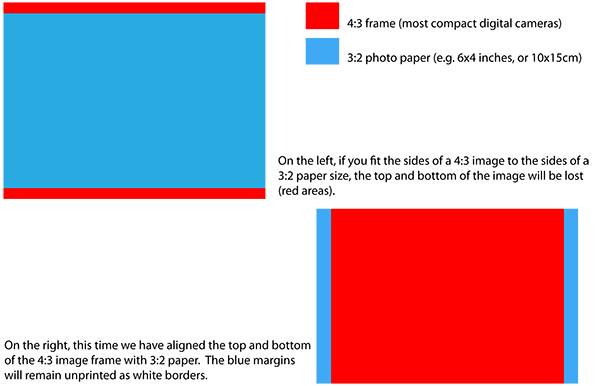
Despite over a decade to adapt, manufacturers of photo printers, both for the home, and the photo lab, have generally stuck with 6x4 inch photo paper. When you get your 4:3 digital photos printed, either at home on your own printer or commercially via a photo lab, your pictures may be returned in one of three forms:
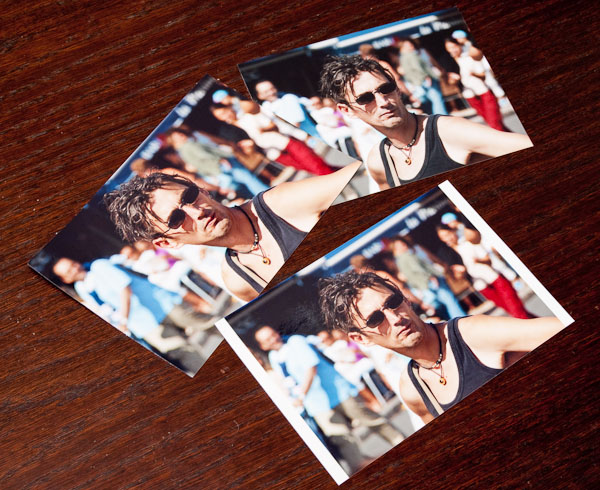
From the left, the first print has cropped the top and bottom, the second (top) print has reproduced the full areas of the picture, and finally (bottom) the whole picture has been printed, but a white border on the shorter sides of the paper has been left.
Let's take a closer look:
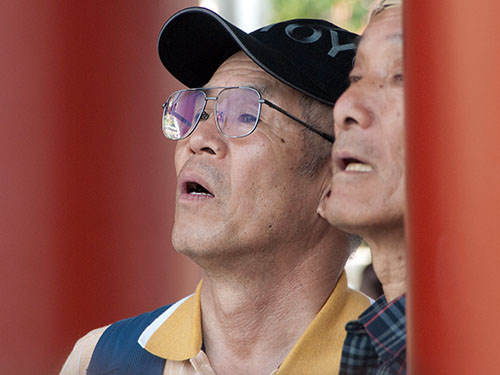
Here (above) is an original 4:3 digital image. As you are encouraged to do at photography school, the framing is tight, with no wasted space.
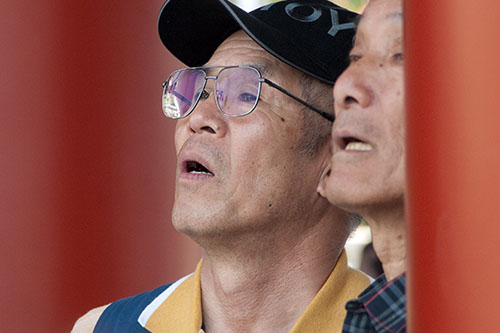
And here (above) the same image as it would appear printed on 6x4 inch paper. Part of the cap and the man's collar have been lost because the top and bottom have been cropped in order to make the sides fit the paper. In reality, there would be a greater crop as there is additional wastage in the process of printing borderless.
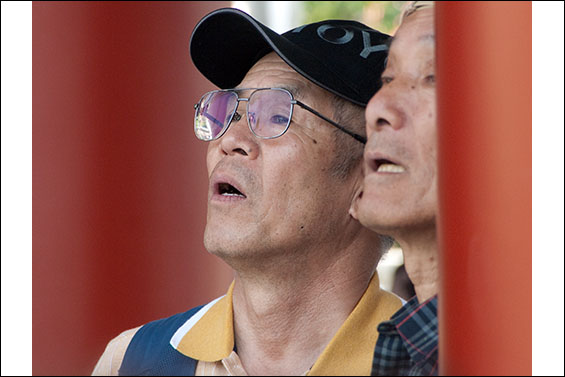
Here (above) is the same picture printed on 6x4 paper where the printer has simply matched the top and bottom of the image with the top and bottom of the paper, leaving two un-printed margins.
What paper sizes fit best?
Thankfully, some commercial printers do offer print sizes that will fit a 4:3 picture better, or perfectly. Even so, surprisingly, some big names continue to ignore the decade-plus digital camera legacy. Kodak's Gallery online photo printing service is a good example, only offering standard print sizes at the smaller end of 6x4 and 5x3.5 inches, neither of which are ideal for 4:3 photos. But there are some services that have seen the light. Pixum is a good example; their system will trim the print according to the image dimensions, within a range that accommodates most variations of camera image aspect ratio. Unfortunately, Pixum and others like them are still in a small minority, and high street photo printing services are generally the least flexible. My advice is to shop around and check that sensible print formats are offered before ordering your prints.
To take some of the leg work out of this, I have listed the most common photo print sizes, including enlargements, and analysed each to see how well, or otherwise, it will work with 4:3 digital camera images.
Paper sizes:
- 5x3.5 inches. This print size has a 1:1.43 aspect ratio, so it falls between the 4:3 (1:1.33) and 3:2 (1:1.5) stools. It's pretty much a useless size for digital photos.
- 5x3.75 inches. This is an increasingly common standard print size that has the same 4:3 format as most digital cameras; an ideal size to look out for.
- 6x4 inches (10x15cm). At 1:1.5, this is the widest (or lowest) commonly used photo printer paper format. It's a perfect match for most DSLRs because they mainly produce 3:2 images by default, as well as standard 35mm film cameras. But for virtually all other digital cameras, including camera phones, and some DSLRs notably from Panasonic Lumix and Olympus, this paper is too wide, meaning you will either see the top and bottom cropped or you will get white borders on the shorter sides.
- 6x4.5 inches. This is a 4:3 format and so is perfect for 4:3 aspect ratio camera images. Like 5x3.75 inch photos this is an increasingly available option and well worth opting for.
- 5x7 inches. An old favourite for modest enlargements, 5x7 prints have an aspect ratio of 1:1.4. This places it inbetween 3:2 and 4:3 formats, but is slightly closer to 4:3.
- 5x7.5 inches. This is perfectly suited for 3:2 aspect images, but too wide for 4:3 images.
- 8x6 inches. Another old favourite and popular for frames, it has an aspect ratio of 4:3 and so is perfect for 4:3 camera images.
- A-series ISO paper sizes (A6, A5, A4, A3, etc.). These are all slightly over 1:1.4 and are a reasonably close match for 4:3 images, but some cropping or trimming will be required..
- 10x7 inches. With a 1:1.43 ratio, this size is not ideal for either 4:3 or 3:2 images.
- 10x 8 inches. This old favourite has aspect ratio of 1:1.25, making it much closer to a 4:3 fit than 3:2.
- 12x8 inches. Best for 3:2 format images, providing a perfect format match.
- 10x12 inches. With an aspect ratio of 1:1.2, this is verging on being square. But it's not a bad match for 4:3; the main cost will be some trimming off the sides of the frame.
- 12x16 inches. This is the same aspect ratio as 4:3, so a perfect match
- 20x16 inches. See comments for 10x8 inch paper.
- 24x20 inches. Here we have the same aspect ratio as 10x12 inch paper.
- 30x20 inches. Perfect for 3:2 images, rather then 4:3 ones.
Reader feedback:
Discuss this story:


