|
|

Follow our fully illustrated introductory tour of the new D50, Nikon's new baby DSLR
Check prices and options for buying a Nikon D50
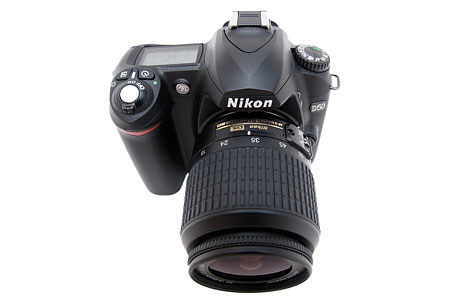
Nikon UK kindly provided DPNow with a pre-production D50, with its new 18-55mm f/3.5-5.6 kit lens for a hands-on session and product photo shoot. Being a pre-production unit with beta firmware, we did not use the camera for taking test pictures. That will wait until we get our hands on a production sample.
The primary purpose of this article is to give you the hands-on feel for the camera that we were able to experience. Apart from this short introduction page, we have provided a gallery of 29 views of the camera and lens, plus a collection of the Nikon D50's system menu screens. You can also compare specifications with the D50's main competitors or examine the detailed manufacturer specifications for the D50.
Nikon is building on the tremendous success that the D70 model has enjoyed since the beginning of 2004. They are now being built at a rate of a million-plus per year, which is remarkable considering the fact that the D70 is not a bargain-basement priced camera. The D50, however, is. Naturally it has lost some of the D70's more advanced features, but it also has a few advantages of its own. It has a newer autofocus system, it's lighter and smaller and it has a face lifted menu system, though the latter has also been introduced in the new revised D70s and you can upgrade your original D70 menus via a firmware upgrade that is now available.
Viewfinder
One thing I was immediately impressed with was the quality of the D50's viewfinder. Even when viewing through the relatively dim f/3.5 18-55 zoom, the view was commendably bright and clear. As with all Nikons, the viewfinder is neatly conceived and functional, though one feature that keen photographers might feel is loss of the D70's tight spot-metering zone.
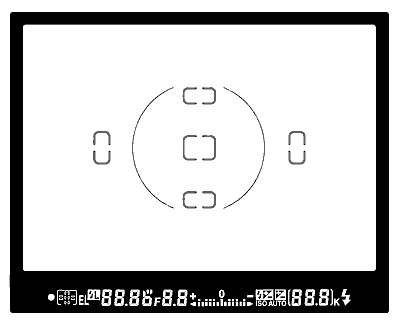
The Nikon D50 viewfinder is almost identical to the D70's, which is, on the whole, a good thing.
The 18-55 standard kit zoom lens is lightweight and not particularly snappy at focusing but it's quiet in operation. According to the manual, the HB-33 lens hood is not a standard item.
There is no waiting for the D50 to power up and when shooting in quick-succession single shot mode or in continuous shooting, I found the responsiveness to be good. Perhaps because of the smaller and lighter body, I could feel some of the inertia of the shutter and mirror action through the body, suggesting it could be better damped, but it's not too bad and the camera is actually relatively easy on the ear.
DPNow Nikon D50 design and construction gallery
Click on a gallery thumbnail image below to see a full-size view of the picture from the Nikon D50 preview gallery.
|
Summary
Nikon has played it safe with the D50. It's conventional-looking and conventional in specification. On the one hand, Nikon has managed to cut costs to make the D50 very affordable without blunting its capability as a photographer's tool. But this does mean, inevitably, that Nikon will attract attention away from the D70s.
Then there is the issue of what I'd call 'showroom appeal'. The D50 is a fine-looking camera, but there is something about the Canon EOS-350D/Rebel XT that I feel has an edge in the 'must-have' style and looks factor when you gaze across the counter in a store. But on the plus-side for the D50, I found it more comfortable to hold than the Canon, which I find a bit too small for comfort.
Also falling under the label of "showroom appeal" is the megapixel factor. The D50 and, indeed, the D70s, are stuck at six megapixels. Both Canon and Olympus can offer eight megapixel DSLRs in the same price bracket. The difference between six and eight megapixels isn't that critical, but that won't stop Nikon losing some customers who must have thet extra resolution.
Another disappointment is that there is no option to fit a battery grip, something that both the Canon EOS-350D/Rebel XT and the Olympus E-300 list as options. A battery grip not only extends the time the camera will operate between recharging and it improves the balance and handling of the camera. It also makes the camera look more 'professional' - we're back that showroom appeal business!
Although our time handling the camera gives us some feel for the D50, the real test is yet to come when we get to take some pictures that we can evaluate critically. We're certainly looking forward to that opportunity in the near future.
Check the latest price or purchase options for the Nikon D50 via

|

| 
|  |
| Click on the flag that best relates to your location |
| The EU flag links to Amazon Germany, currently the only European Amazon outlet that supplies electronic goods like cameras priced in Euros. |
| Each Amazon outlet can ship to most countries in the world. |
Menu screens
A look at the D50's menus
The Nikon D50 and the D70s have tidied-up menu screens with a more easy on the eye yellow, black and grey colour scheme.
Navigation is quite straightforward and as you can see below, there are some nice touches to round-off the menu system nicely. Menu navigation proved to be quick and instant, with little confusion or mis-keying, though the image annotation feature is rather long-winded to use.
The available options are sometimes very sophisticated for a camera that is probably going to be bought by less ambitious photographers, but it's good news for keen photographers unable to stretch to a D70.
We'll investigate the D50 menu options in greater depth when we review the camera fully.

The new menus mainly use shades of
yellow and grey and some green. |

The camera symbol denotes 'shooting'
menu mode.
| 
Simultaneous JPEG and RAW file
shooting mode is provided. |

Providing a grey scale to calibrate
the monitor screen is a nice touch
| 
Setup menu houses a miscellany
of settings options. |
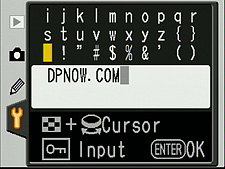
Short phrases can be input to
annotate individual frames
| 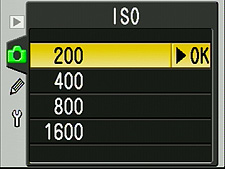
The D50's ISO setting range lacks
both 100 and 3200 options |

There are plenty of options if you
like in-camera image processing
| 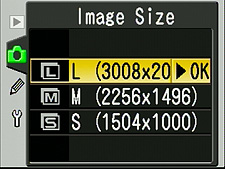
Three image resolutions are offered.. |
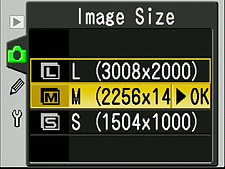
..though the minimum resolution is
no smaller than 1504x1000
| 
White balance options are pretty
comprehensive. |
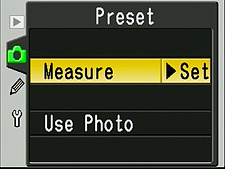
Custom calibration of white balance can be based on a previous photo.
| 
Choosing the most suitable white
Balance option. |

Or just use good old auto.
|
Here is the summary view of basic
camera settings |

This is the custom settings menu.
|
Check the latest price or purchase options for the Nikon D50 via

|

|
|  |
| Click on the flag that best relates to your location |
| The EU flag links to Amazon Germany, currently the only European Amazon outlet that supplies electronic goods like cameras priced in Euros. |
| Each Amazon outlet can ship to most countries in the world. |
Specifications compared
| Model | Canon EOS-350D (Digital Rebel XT) | Nikon D70 | Nikon D70s | Nikon D50 | Olympus E-300 (Evolt) | Pentax *istDS
| | Typical price (UK)* | £649 | £749 | £899 (msrp)** | £649 (msrp)** | £579 | £669
| | Typical price (USA)* | $929 | $999 | $1199 (est) | $899(est) | $799 | $899
| | Typical price (Euros)* | €819 | €1089 | €1343 (est)** | €971 (msrp)** | €749 | €949
| | Megapixels | 8 | 6 | 6 | 6 | 8 | 6
| | Kit lens | EF-S 18-55mm (29-88mm equiv) f/3.5-5.6 | AF-S DX 18-70mm (27-105mm equiv) f/3.5-4.5G IF-ED | AF-S DX 18-70mm (27-105mm equiv) f/3.5-4.5G IF-ED | AF-S DX 18-55mm (27-83mm equiv) f/3.5-5.6G ED | Zuiko Digital 14-45mm (28-90mm equiv) f/3.5-5.6 | DA 18-55mm (27-83mm equiv) f/3.5-5.6 AL
| | Shutter speed range | Bulb-1/4000th sec | Bulb-1/8000th sec | Bulb-1/8000th sec | Bulb-1/4000th sec | 8min-1/4000th sec | Bulb-1/4000th sec
| | Flash sync speed | X=1/200th sec | X=1/500th | X=1/500th | X=1/500th | X=1/180th or 1/4000th (Super FP) | X=1/180th
| | Max continuous shooting speed/frames (JPEG) | 3fps/14 frames | 3fps/12 frames | 3fps/until card filled with high performance card | 2.5fps/until card filled with high performance card | 2.5fps/4 frames | 2.8fps/8 frames
| | LCD size/resolution | 1.8in/115,000 pixels | 1.8in/130,000 pixels | 2.0in/130,000 pizels | 2.0in/130,000 pizels | 1.8in/134,000 pixels | 2.0in/210,000 pixels
| | Special features | Photostitch panorama software, E-TTL flash compatibility | i-TTL distance related flash system, grid lines in viewfinder, extensive customisable image settings | i-TTL distance related flash system, grid lines in viewfinder, extensive customisable image settings, fast power up | i-TTL distance related flash system, compact design, SD card support (no CF), fast power up | Porro viewfinder, supersonic wave sensor cleaner | Compact design, SD card support (no CF)
| | Body only dimensions/weight (no battery, card or strap) | 126.5x94.2x64 mm/485g | 140x111x78mm/595g | 140x111x78mm/600g | 133x102x76mm/540g | 146.5 x 85 x 64mm/580g | 125x 92.5x 66mm/505g
|
Check the latest price or purchase options for the Nikon D50 via
|
|
|
| |
| Click on the flag that best relates to your location |
| The EU flag links to Amazon Germany, currently the only European Amazon outlet that supplies electronic goods like cameras priced in Euros. |
| Each Amazon outlet can ship to most countries in the world. |
Full specification
| Type of Camera |
Single-lens reflex digital camera
| | Effective Pixels |
6.1 million
| | Image Sensor |
RGB CCD, 23.7 x 15.6mm; total pixels: 6.24 million
| | Image Size (pixels) |
3,008 x 2,000 [L], 2,256 x 1,496 [M], 1,504 x 1,000 [S]
| | Sensitivity |
200 to 1600 (ISO equivalent) in steps of 1 EV
| | Storage Media |
SD Memory Card
| | Storage System |
Compressed NEF (RAW): 12-bit compression,
JPEG: JPEG baseline-compliant
| | File System |
Exif 2.21, Compliant DCF 2.0 and DPOF
| | Storage (Number of frames per 256MB SD Memory card, image size L)
| RAW approx. 33, FINE approx. 70
NORMAL approx. 137
BASIC approx. 258,
RAW & BASIC approx. 29
| | White Balance |
Auto (TTL white balance with 420-pixel RGB sensor), six manual
modes, preset white balance, white balance bracketing possible
| | LCD Monitor |
2.0-in., 130,000-dot, low-temperature polysilicon TFT LCD
with brightness adjustment
| | Playback Function |
1 frame: Thumbnail (4 or 9 segments); Magnifying playback; Slide
show; Histogram indication; Highlight point display; Auto image
rotation
| | Delete Function |
Card format, All frames delete, Selected frames delete
| | Video Output |
Can be selected from NTSC and PAL
| | Interface |
USB 2.0 (Hi-Speed)
| | Text Input |
Up to 36 characters of alphanumeric text input available with LCD
monitor and multi-selector; stored in Exif header
| | Compatible Lenses |
1) DX Nikkor: All functions supported
2) Type G or D AF Nikkor: All functions
3) Micro Nikkor 85 mm F2.8D:
All functions supported except autofocus and some exposure modes
4) Other AF Nikkor: All functions supported except 3D Colour Matrix Metering II,
i-TTL Balanced Fill-Flash for digital SLR
5) AI-P Nikkor : All functions supported except 3D Colour Matrix Metering II,
i-TTL Balanced Fill-Flash for digital SLR, and autofocus
6) Non-CPU : Can be used in exposure mode M,
but exposure meter does not function;
electronic range finder can be used if maximum aperture is f/5.6 or faster Note: IX Nikkor lenses can not be used
| | Picture Angle |
Equivalent in 35mm [135] format is approx. 1.5 times lens focal length
| | Viewfinder |
Fixed eye-level penta-Dach-mirror type; built-in diopter adjustment
(-1.6 to +0.5m-1)
| | Eyepoint |
18mm (-1.0m-1)
| | Focusing Screen |
Type-B BriteView Clear Matte screen Mark V with superimposed
focus brackets
| | Viewfinder Frame Coverage |
Approx. 95%
| | Viewfinder Magnification |
Approx. 0.75x with 50mm lens at infinity; -1.0m-1
| | Viewfinder Information |
Focus indications, AE/FV lock indicator, Shutter speed,
Aperture value, Exposure/Exposure compensation indicator,
Flash output level compensation, Exposure compensation,
Number of remaining exposures, Flash ready indicator
| | Autofocus |
TTL phase detection by Nikon Multi-CAM900 autofocus
module with AF-assist illuminator (approx. 0.5m to 3.0m)
Detection range: EV -1 to +19
(ISO 100 equivalent, at normal temperature: 20°C)
| | Lens Servo |
1) Autofocus (AF-A): Auto-Servo AF; camera automatically
chooses single-servo AF (AF-S) or continuous servo AF (AF-C);
predictive focus tracking automatically activated according to
subject status
2) AF-S
3) AF-C
4) Manual focus (M)
| | Focus Area |
Can be selected from 5 focus areas
| | AF Area Mode |
1) Single Area AF,
2) Dynamic Area AF,
3) Closest Subject Priority Dynamic Area AF
| | Focus Lock |
Focus can be locked by pressing shutter-release button halfway
(single-servo AF) or by pressing AE-L/AF-L button
| | Exposure Metering System |
TTL full-aperture exposure metering system
(1) 3D Colour Matrix Metering II with 420-pixel RGB sensor
(2) Center-weighted: Weight of 75% (8mm dia. circle)
(3) Spot: Meters 3.5mm dia. circle (about 2.5% of frame)
centered on active focus area
| | Exposure Metering Range |
1) EV 0 to 20 (3D Colour Matrix or center-weighted metering)
2) EV 2 to 20 (spot metering) (ISO 100 equivalent, f/1.4 lens, 20°C)
| | Exposure Modes |
Digital Vari-Program (Auto, Portrait, Landscape, Child, Sports,
Close up, Night portrait),
Programmed Auto [P] with flexible program; Shutter-Priority Auto [S];
Aperture Priority Auto [A]; Manual [M]
| | Exposure Compensation |
±5 EV in increments of 1/3 or 1/2 EV
| | Auto Exposure Lock |
Luminosity locked at detected value with AE-L/AF-L button
| | Auto Exposure Bracketing |
Three frames ±2 EV in 1/3 or 1/2 steps
| | Shooting Modes |
1) Single frame shooting mode
2) Continuous shooting mode: approx. 2.5 frames per second
3) Self-timer mode
4) Delayed remote mode: 2 sec. delay
5) Quick–response remote mode
| | Shutter |
Combined mechanical and CCD electronic shutter, 30 to 1/4000 sec.
in steps of 1/3 or 1/2 EV, bulb
| | Sync Contact |
X-contact only; flash synchronization at up to 1/500 sec.
| | Flash Control |
1) TTL: TTL flash control by 420-pixel RGB sensor
Built-in Speedlight: i-TTL Balanced Fill-Flash or standard i-TTL
flash (spot metering) SB-800 or 600: i-TTL Balanced Fill-Flash or
standard i-TTL flash (spot metering)
2) Auto aperture: Available with SB-800 with CPU lens
3) Non-TTL Auto: Available with Speedlights such as SB-800,
80DX, 28DX, 28, 27, and 22s
4) Distance-priority manual available with SB-800
| | Flash Sync Mode |
1) Front-curtain Sync (normal sync),
2) Red-eye Reduction,
3) Red-eye Reduction with Slow Sync,
4) Slow Sync,
5) Rear-curtain Sync
| | Built-in Speedlight |
Auto, Portrait, Child, Close-up, Night portrait: auto flash with
auto pop-up [P], [S], [A], [M]: manual pop-up with button release
Guide number (ISO 200/ISO 100, m): approx. 15/11 (manual full 17/12)
| | Flash Compensation |
-3 to +1 EV in increments of 1/3 or 1/2 EV
| | Accessory Shoe |
Standard ISO hot-shoe contact with safety lock provided
| | Self-timer |
Electronically controlled timer of 2 to 20 seconds duration
| | Remote Control |
Wireless Remote Controller ML-L3 (optional)
| | Power Source |
One Rechargeable Li-ion Battery EN-EL3, AC Adapter EH-5 (optional)
| | Tripod Socket |
1/4 in. (ISO1222)
| | Dimensions (W x H x D) |
Approx. 133 x 102 x 76mm
| | Weight |
Approx. 540g without battery, memory card, or body cap
| | Supplied Accessories* |
Rechargeable Li-ion Battery EN-EL3, Quick Charger MH-18a,
Video Cable, USB Cable UC-E4, Strap, Body cap, Eyepiece Cap DK-5,
Rubber Eyecup DK-20, Accessory shoe cover, PictureProject CD-ROM
| | Optional Accessories |
Rechargeable Li-ion Battery EN-EL3, Multi Charger MH-19,
Quick Charger MH-18a, AC Adapter EH-5, Speedlight SB-800/600,
Eyepiece Magnifier DG-2, Angle Finder DR-6, Nikon Capture 4 (Ver.4.3)
Software, Wireless Remote Control ML-L3, Semi-Soft Case CF-D50
*Supplied accessories may differ in each country or area
|
Specifications and equipment are subject to change without any notice
or obligation on the part of the manufacturer. April 2005
©2005 Nikon Corporation
Check the latest price or purchase options for the Nikon D50 via
|
|
|
| |
| Click on the flag that best relates to your location |
| The EU flag links to Amazon Germany, currently the only European Amazon outlet that supplies electronic goods like cameras priced in Euros. |
| Each Amazon outlet can ship to most countries in the world. |
|
|


